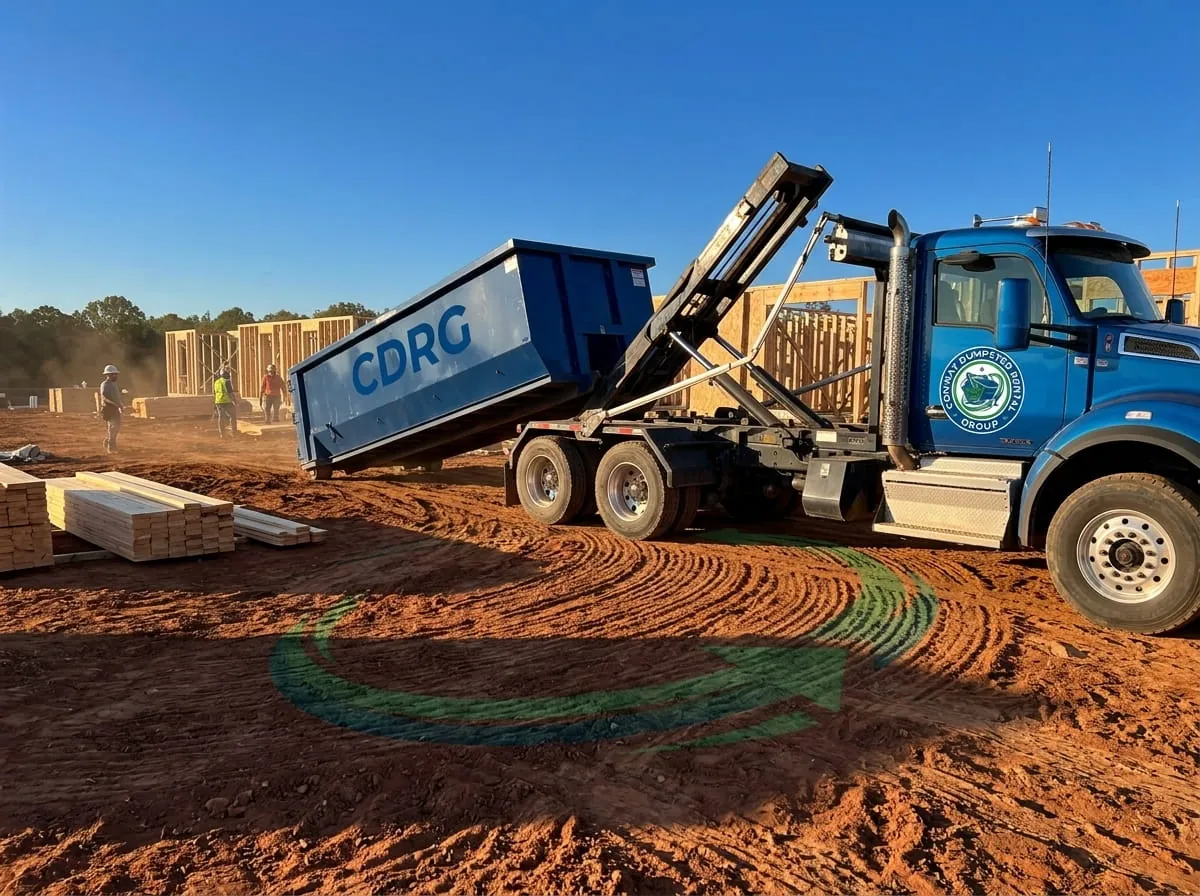
If you have never torn shingles off a roof, the first surprise is not how much room they take up. It is how much they weigh. A pile of used shingles looks modest sitting in the driveway, then you go to move it and your back tells you the truth. On a roofing dumpster, weight is almost always the limiting factor, not volume. Get that one idea right and everything else about sizing your bin falls into place.
At Conway Dumpster Rental Group we drop bins for roofers and homeowners across Faulkner County and Central Arkansas every week, and the tear-offs that go smoothly all share the same habits: the right size can, placed close to the work, with a plan for containing the mess. Here is how to think it through before you ever pop the first shingle.
Why shingles are so deceptively heavy
Roofing is measured in squares. One square equals a 10-by-10 area of roof, or 100 square feet. A standard three-tab asphalt shingle square weighs somewhere in the neighborhood of 230 to 250 pounds new, and architectural or dimensional shingles run heavier, often 400 to 450 pounds per square. Now add everything that comes off with them: felt or synthetic underlayment, old flashing, drip edge, sometimes a layer of decking, and whatever grit and moisture the shingles have soaked up over fifteen or twenty Arkansas summers.
Torn-off material also weighs more than new material. Old shingles hold water, and a roof that got rained on the night before you tear it off is heavier still. That matters here, because a Central Arkansas tear-off scheduled around a passing thunderstorm can gain hundreds of pounds of trapped moisture between Friday and Monday.
The practical takeaway: a dumpster you could physically fill with shingles two or three times over will hit its weight limit long before it looks full. That is not a flaw in the bin. It is physics, and it is exactly why the smaller cans are usually the smart call for roofing.
Estimate your load by squares and layers
You need two numbers to size a roofing dumpster: how many squares of roof you are removing, and how many layers are up there.
Squares are easy enough. If you know your roof's footprint and pitch you can calculate it, but most homeowners can get close by asking their roofer or checking an old invoice. A typical single-story ranch in Conway might run 15 to 25 squares. A larger two-story home with a steep, cut-up roof can push past 35.
Layers are the number people forget. Building codes often allowed a second layer of shingles to be installed right over the first, so plenty of older Faulkner County homes are carrying two layers, occasionally three. Every extra layer roughly multiplies your tear-off weight. Two layers of architectural shingle over 25 squares is a serious load, easily well over 10,000 pounds, and that changes your sizing entirely.
The most common mistake we see is a homeowner ordering by how much stuff they think will fit, then discovering the roof had a hidden second layer. Count layers before you order, not after the crew is already on the roof.
To count layers without climbing up, look at a cut edge of the roof at the rake or eave, or pull a shingle at an inconspicuous spot. If you are hiring a roofer, they will know from the estimate. If in doubt, assume the heavier case and give us a call so we can right-size it with you.
A rough sizing guide for shingle tear-offs
Use this as a starting point, not gospel. Actual weight depends on shingle type, moisture, and whether decking comes off too. When you are between two sizes on a roofing job, the smaller bin with a higher weight allowance is often the better fit than a bigger bin you can only fill a third of the way.
| Roof size | Layers | Suggested bin |
|---|---|---|
| Up to 15 squares | 1 layer | 10-yard |
| Up to 15 squares | 2 layers | 10 to 15-yard |
| 15 to 25 squares | 1 layer | 15-yard |
| 15 to 25 squares | 2 layers | 15-yard (watch weight) |
| 25 to 35 squares | 1 layer | 15 to 20-yard |
| 25 to 35 squares | 2 layers | Two hauls or a 20-yard with tonnage |
| Architectural shingle, any size | Any | Size up one, or plan a swap-out |
Notice the pattern: for most residential roofs, a 10-yard dumpster or a 15-yard dumpster handles the job. Those compact cans are built low to the ground, they load fast, and they carry the tonnage that heavy debris demands without leaving you paying for air. If you are torn between sizes, our guide to choosing a dumpster size walks through the decision in more detail, or just call us and describe the roof.
Not sure how many squares you have or how many layers are up there? Call Conway Dumpster Rental Group at (501) 585-7772 and we will size it with you in a couple of minutes.
Why a smaller bin is often the right bin
It feels counterintuitive, but a smaller dumpster frequently wins on a roofing job for three reasons. First, weight limits mean you physically cannot fill a large bin with shingles anyway, so you are paying for capacity you will never use. Second, the low profile of a 10 or 15-yard can makes it far easier to toss shingles in from a tarp or a wheelbarrow, and easier to hit from a roof edge on a single-story home. Third, a smaller footprint is kinder to your driveway and leaves more room for the crew to work around it.
On big or double-layer jobs, the answer is not always one giant can. Sometimes the cleaner plan is a right-sized bin with a scheduled swap-out, so you get a fresh empty can mid-day and never stop working. We can set that up ahead of time so the timing lines up with your crew's pace.
Placement: close to the work, and protect that driveway
Tear-off is a game of repetition. Every extra step between the roof and the dumpster gets multiplied by hundreds of shingle bundles worth of debris. Place the bin as close to the tear-off zone as you safely can, ideally right below the section you are working, so shingles can go from tarp to can with minimal carrying. On a single-story roof, crews often slide debris straight down a tarp chute into a bin parked at the eave.
Guarding your driveway and yard
Roll-off cans are heavy, and roofing debris is abrasive. A few minutes of prep saves you a repair bill:
- Lay down two-by-fours or plywood boards where the wheels and rear of the bin will rest, spreading the load and keeping steel off your concrete or asphalt.
- On a hot Arkansas afternoon, asphalt driveways soften and mark more easily, so boards matter even more in July and August.
- If you would rather keep the driveway completely clear, we can often set the can on the street or a level yard spot. Just ask when you book.
Tell us where you want it when you call and our driver will place it with the door facing your work area so loading stays easy.
Keep the nails and debris contained
The debris that ends up outside the dumpster is the debris that flattens a tire or ends up in a bare foot. A little containment discipline goes a long way:
- Tarp the ground around the house before you start. Catching shingles and nails on tarps rather than in the grass makes cleanup dramatically faster.
- Load steadily rather than overfilling. Shingles piled above the rails can slide off in transport, and by law we cannot haul a can loaded over the top edge.
- Run a magnetic sweeper across the driveway, walkways, and lawn at the end of the day and again after the roof is buttoned up. Roofing nails are the number one leftover hazard.
- Keep loose felt and wrappers weighted down or bagged so Central Arkansas wind does not scatter them across the neighborhood.
Planning for a fast tear-off day
Tear-off is the part of a roof replacement where a dry, well-run day makes all the difference. Once the old roof is off, the deck is exposed, so you want to strip, inspect, and dry it in before weather moves back through. In Central Arkansas that means watching the forecast closely and keeping the schedule tight.
A few things to line up in advance:
- Have the dumpster on site the day before or first thing that morning, so the crew is never waiting on a can.
- Confirm your size and layer count ahead of time so there are no surprises when tear-off reveals a hidden second layer.
- If it is a large or two-layer roof, pre-arrange a swap-out or a second haul so a full bin never stalls the work.
- Book early during storm season. After a hail or wind event rolls through Faulkner County, roofing bins get scarce fast.
We know how roofing schedules run, and we keep our roll-off delivery flexible to match. Whether you are a homeowner doing a single tear-off or a roofer running back-to-back jobs, we will get the right can where you need it, when you need it.
Ready to line up your bin? Learn more about our roofing dumpster rental service, or call Conway Dumpster Rental Group at (501) 585-7772 to book a tear-off can sized to your roof.
Founder, Conway Dumpster Rental Group — sharing straight advice from more than 15 years of local hauling experience.
Frequently Asked Questions
What size dumpster do I need for a roof tear-off?
For most Conway homes, a 10-yard or 15-yard dumpster handles a single-layer tear-off. A 10-yard suits roofs up to about 15 squares, while a 15-yard covers roughly 15 to 25 squares. Because shingles are heavy, these compact cans with generous weight limits usually beat oversizing. Count your layers first, then call us at (501) 585-7772 to confirm.
Why can't I fill a roofing dumpster all the way to the top?
Shingles are extremely heavy, so a roofing dumpster almost always reaches its weight limit before it looks full. A square of architectural shingle can weigh 400 pounds or more, and old shingles hold water that adds even more. Loading above the rails also makes the can unsafe and illegal to haul, so we size by weight, not just volume.
How do I know how many layers of shingles are on my roof?
Look at a cut edge at the eave or rake and count the shingle courses stacked there, or lift a shingle at an out-of-the-way spot. If you are hiring a roofer, the estimate will note the layer count. Older Faulkner County homes often carry two layers, which roughly doubles the tear-off weight, so confirm before you order a bin.
Will a dumpster damage my driveway during a roofing job?
It can if you skip prep, since roll-off cans are heavy and roofing debris is abrasive. Lay two-by-fours or plywood under the wheels and rear of the bin to spread the load, which matters even more on hot Arkansas afternoons when asphalt softens. We can also place the can on the street or a level yard spot instead. Just tell us when you book.
How far in advance should I book a roofing dumpster in Conway?
Book as early as you can, especially during storm season. After hail or high winds hit Faulkner County, roofing bins get reserved quickly as crews line up back-to-back jobs. Having the can on site the day before tear-off keeps your crew from waiting. Call Conway Dumpster Rental Group at (501) 585-7772 to lock in your delivery date.